As I mentioned before, we have a 'Southbridge' subsystem which concentrates all I/O access. This Southbridge is implemented by the MCPX chip.
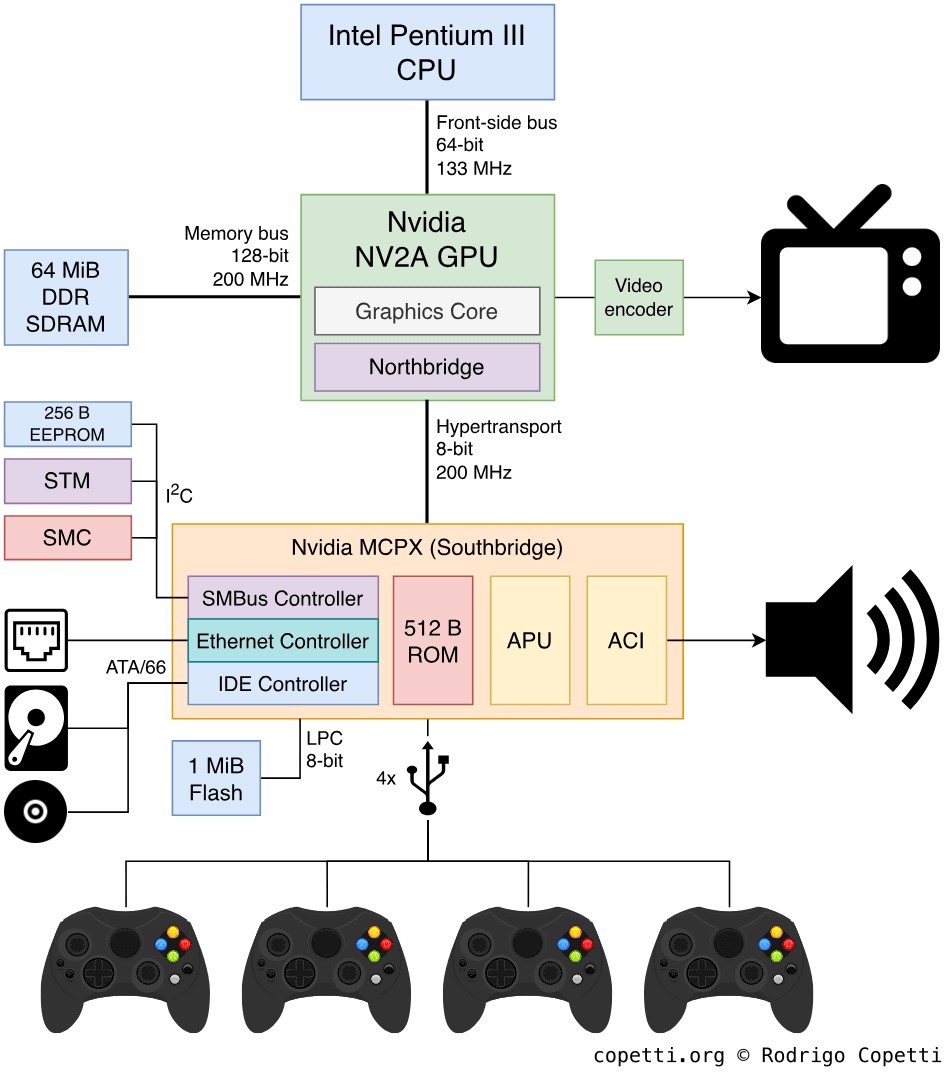
Main diagram of the console's architecture. Notice how the MCPX controls most of the I/O.
Incidentally, the MCPX derives from its PC counterpart called nVidia nForce Multimedia and Communications Processor or 'MCP'. This is found on motherboards using the nForce 220/415/420 chipset .
External interfaces
The console includes the following external connectors:
- 4 USB 1.1 ports: Used to connect the controllers, however, the external shape of the port is modified to only allow Xbox controllers.
- These ports also contain an extra pin called 'Video Sync' to connect peripherals that interact with the screen.
- 10/100BASE-TX Ethernet port: Used for online services (more details later). The actual Ethernet function is performed by a separate transceiver found in the motherboard.
Internal interfaces
The MCPX also provides the following interfaces and protocols used to interconnect different subsystems:
- SMBus: Also referred to as I²C, it's a serial interface that connects these components:
- System Management Controller or 'SMC': Manages multiple services, such as power, temperature and fan control. It's actually a PIC16LC microcontroller.
- System Temperature Monitor or 'STM': A digital thermometer (ADM1032) used by the SMC to detect overheating.
- A 256 B EEPROM: A re-writable ROM that stores unique identifiers (serial number, region, Ethernet MAC address, etc).
- Video Encoder: The encoder is primarily connected to the GPU but controlled through the SMBus.
- IDE Controller: This is a standard protocol widely used on PCs to communicate with Hard drives, optical readers and so forth. A single wide ribbon cable is used to connect the motherboard with the DVD drive and the HDD.
- Low Pin Count or 'LPC' bus: This is another interface borrowed from the PC, but instead of connecting the good old PC BIOS, it communicates with a Flash ROM, which in turn stores the equivalent of a BIOS. The Flash is 1 MiB large.
The controller
The Xbox came with a bulky controller called The Duke, its set of inputs isn't any different from what the other competitors had... except for the usage of analogue circuitry (8-bit wide) on the face buttons, allowing games to detect 'half-presses' from most of the button set. On the other side, the Duke was so widely criticised that Microsoft replaced it with a new revision called Controller S months after the release of the console.
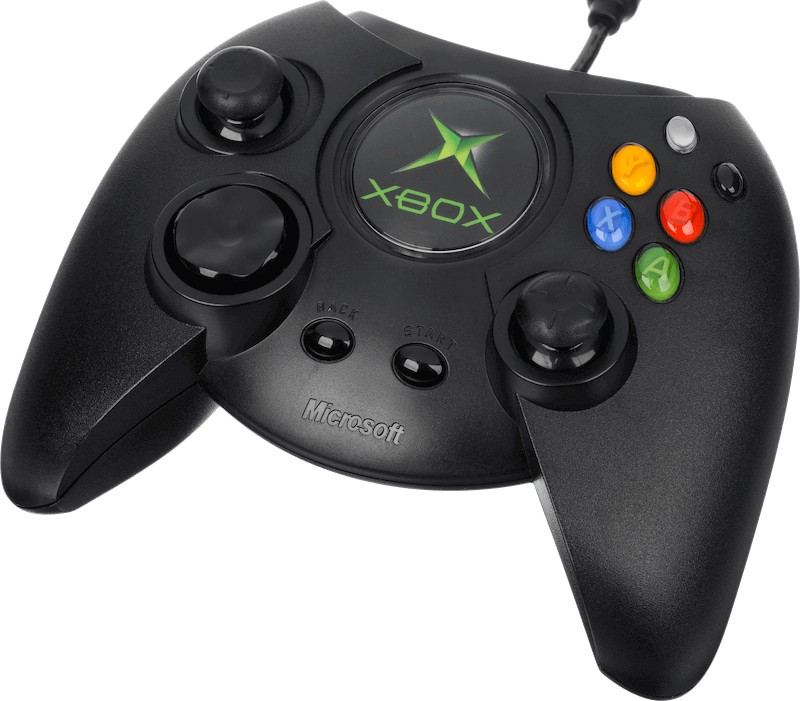
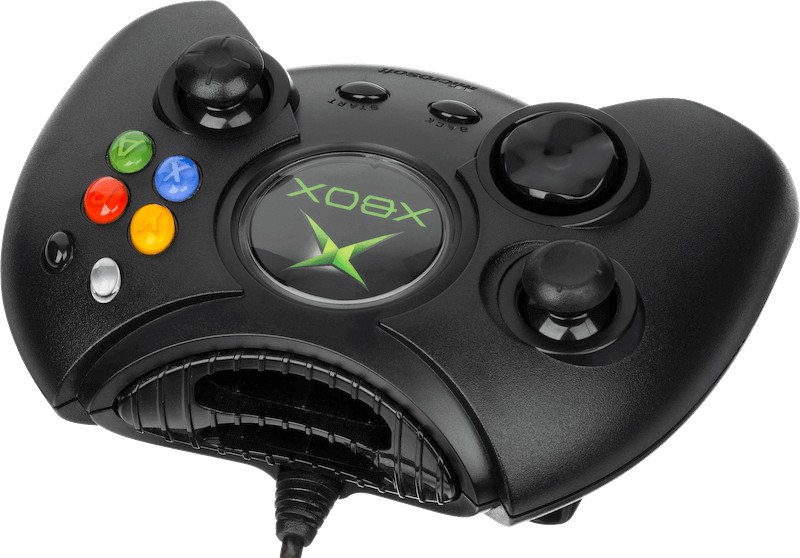 The Duke (2001) .
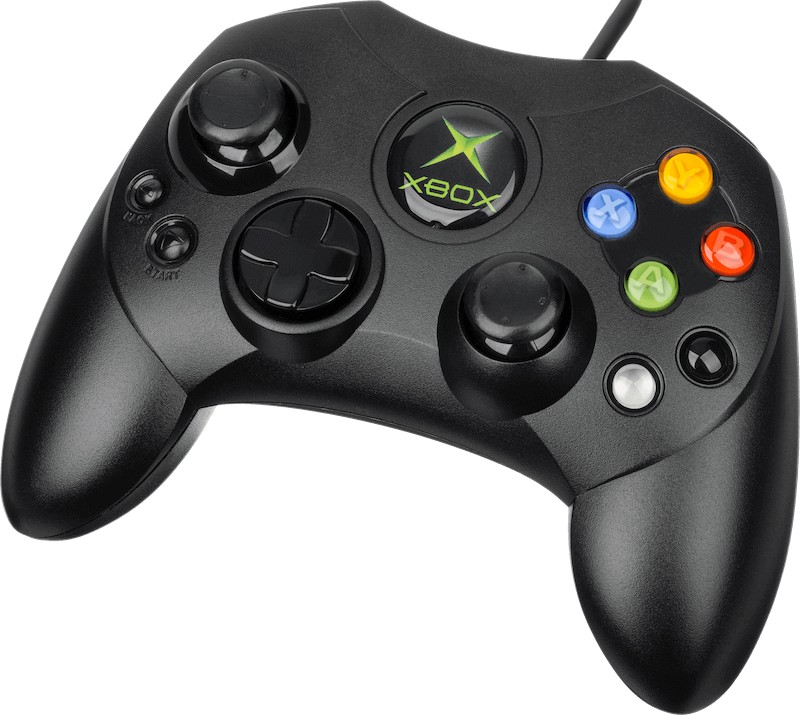
 Controller S (2002) .
On closer inspection, both controllers did include something special: Two Memory Unit slots to plug in a proprietary memory card, enabling to share saves between consoles. Upon realising this, I instantly assumed this feature was inherited from a previous competitor. However, days after publishing this article, I sent it to Seamus Blackley, the co-creator of this console, who quickly replied with very interesting comments. Regarding the Dreamcast similarities, he told me:
The relationship to Dreamcast is just historical bias. That was accidental.
- Seamus Blackley
A required adapter
Another interesting fact to mention about these controllers is that they can only be plugged in using a shape adapter referred to as breakaway dongle, this was designed in an effort to prevent accidents when someone tripped over.
I think they also planned for where an Xbox was on a high shelf and yanking the controller would pull the whole heavy console down on some kid's head.
- Xbox user