Imagine taking the Game Boy's wave channel, multiplying it by five and adding a noise channel: that's pretty much the offering of the Virtual Boy's sound chip. It can also be regarded as a sibling of the PC Engine's audio system.
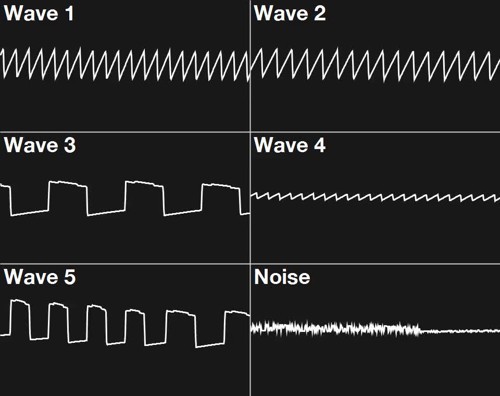
Video - Oscilloscope display of Mario's Tennis (1995), showing all the audio channels.
In the motherboard, there is a chip called Virtual Sound Unit (VSU) that provides the sound capabilities. The VSU relies on internal RAM to store five wavetables and a register file to configure each of the six channels available (five waves and one noise).
Registers are 8 bits wide, while the internal RAM is connected to a 6-bit data bus. The CPU still treats 6-bit words as a single byte, discarding the upper two bits.
Each wavetable is made of 32 PCM samples encoded in 6-bit values. Channels support panning control (using a volume level value, ranging from 0 to 15, for each left and right) and an 11-bit frequency control.
Each channel also includes basic envelope control, allowing the volume to grow or decay over time.
The fifth channel offers more effects, namely a sweeping function to progressively shift the frequency, and a modulator to alter the waveform based on values stored in the internal RAM.
Meanwhile, the sixth/last channel can only output noise.
Output
The mixed output is stereo, with a 10-bit resolution and a sampling rate of 41.7 kHz. It's also worth pointing out that the console has stereo speakers, so you don't have to wear headphones to enjoy this!