The audio capabilities of this console were part of a broader digital revolution taking place during the same period. In essence, the combination of new storage formats and affordable (yet sophisticated) sample synthesisers ultimately unlocked the composers' ability to produce their music in-house, and then incorporate it directly into games in its original form.
The tech stack
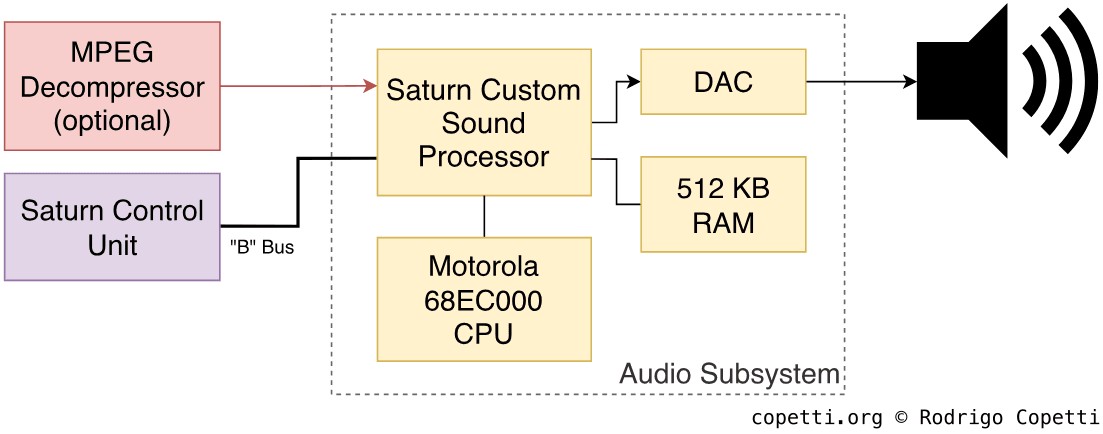
Overview of the audio components.
Be that as it may, beneath the surface of attractive functionality lies a complex arrangement. In the case of the Sega Saturn, its sound subsystem is composed of several parts :
- The Saturn Custom Sound Processor (SCSP): Also referred to as the Yamaha YMF292, it's composed of two modules:
- A multi-function sound generator: Processes up to 32 channels with PCM samples (up to 16-bit at 44.1 kHz - a.k.a. 'CD quality') or FM channels. In the case of the latter, a subset of channels is reserved for operators.
- This component provides pitch scaling, envelope generator, Low-Frequency Oscillator (LFO), and volume and stereo panning.
- A Digital Signal Processor (DSP): Applies audio effects such as echo, reverb, and chorus. The documentation also mentions 'filters', but it's unclear whether this means envelope or frequency-based filters (e.g. low-pass).
- A multi-function sound generator: Processes up to 32 channels with PCM samples (up to 16-bit at 44.1 kHz - a.k.a. 'CD quality') or FM channels. In the case of the latter, a subset of channels is reserved for operators.
- A Motorola 68EC000: Controls the audio components and interfaces with the main CPUs. It executes a sound driver to operate the neighbouring modules.
- If this CPU looks familiar, that's because it is: the Mega Drive carried a 68000 as its main CPU, while the 68EC000 in the Saturn is a cost-reduced variant designed for embedded applications. The latter runs at 11.3 MHz and is connected using a 16-bit bus .
- 512 KB of RAM: Named 'sound RAM', it's used to store the sound driver and audio data (e.g. PCM samples). It also serves as a working area for the DSP.
In a nutshell, the audio pipeline works as follows:
- Either main CPU initialises the aforementioned components and loads a sound driver into sound RAM. It then activates the Motorola 68EC000, so it can begin working.
- During gameplay, the audio subsystem may receive data in the following ways:
- The main CPU can instruct the Saturn Control Unit (SCU) to transfer PCM samples (or other data) from the CD to sound RAM.
- The CD subsystem may send audio data from uncompressed audio tracks (called CD-DA) directly to the SCSP.
- If the 'Video CD' card is installed, the CD subsystem can forward compressed audio to the card, which in turn decompresses it and passes it on to the SCSP.
- Based on the sound driver running and the data received, the Motorola 68EC000 tasks the SCSP to generate the audio. This may involve allocating channels for FM synthesis or PCM playback, both of which have many effects at their disposal.
The opportunity
As previously mentioned, the new audio subsystem allowed studios to finally record and produce soundtracks in-house, then bundle them in the game without the need for rearrangement - unlike earlier systems that relied on constrained sequencers or sound hardware with strict synthesis methods.
This shift was made possible thanks to a combination of key factors:
- The adoption of CD-ROM as storage medium for games allowed developers to store large and high-quality soundtracks.
- The audio endpoint could receive and mix PCM data with acceptable fidelity.
- The audio subsystem offered sufficient power and bandwidth to stream compressed PCM data and decode it in real time.