The PSP has plenty of connections and sensors to discuss. However, I'm taking this opportunity to also introduce some chipsets that haven't been mentioned yet. These play a big part in managing the circuitry that detects the player's input.
Internal interfaces
Most of the available I/O is linked through the Peripheral Bus. It's only 32 bits wide, which is enough to transfer simple information at a normal pace. This bus has access to the main RAM as well.
The D-pad, joystick, and buttons are handled by a unique chip referred to as System Control or 'SysCon'. This is a common codename across Sony hardware, and it deals with interfacing many internal components - although in the PSP's case, SysCon only handles the physical buttons.
External interfaces
The console features a good amount of connections :
- 802.11b Wi-Fi: either connects to a hub or operates in 'ad hoc' mode to talk to nearby PSPs. This is similar to what the Nintendo DS offered.
- USB 2.0: for accessories or to plug the console into a computer. In the case of the latter, the PSP is recognised as a mass storage device, providing access to the memory stick.
- IrDA: stands for 'Infrared Data Association', similar to what a TV remote uses to change the channel. Before the release of the PSP, the infrared protocol was popular for transferring multimedia between a camera/phone and the computer. As for the PSP, however, the IrDA port went bluntly ignored.
- As tends to happen, Sony removed it with the second revision of the PSP (model '2000').
Commercial accessories
The use of a standard port, the USB, incentivised third-parties to design accessories for this console.
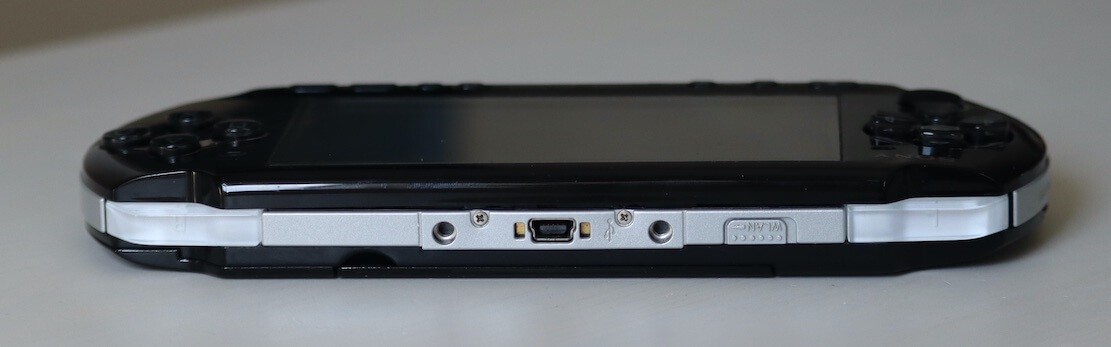
Top side of the PSP (model 3000).
Notice the two holes surrounding the mini USB port to hold an accessory.
Examples of commercialised accessories included:
- A microphone for audio chatting.
- A GPS receiver, to use with the Go! Explore GPS disc, for satellite navigation.
- A camera for videoconferencing. This makes sense as Skype came included with the system.
The interesting part is that these types of peripherals were already available in the Pocket PCs and PDAs market as well. This makes you wonder if Sony envisioned the PSP as a Pocket PC for youngsters.
Home console connectivity
After the release of the PlayStation 3, a new feature appeared on the PSP: Remote Play. Using a Wi-Fi connection, the PS3 could be remotely controlled from the PSP.
The idea actually predated the launch of the Wii U. Unfortunately, only a handful of PS3 games supported Remote Play, meaning users could only navigate through the menus, do some multimedia, and play PlayStation 1 games.