For the first time in this series, games developed for this console are not written for bare-metal. Instead of relying on memory addresses and ports, they must call modules to perform operations on the hardware. In fact, the APIs found in the official SDK are designed around this model.
Development ecosystem
The development toolkit provided by Sony to game studios was produced by SN Systems (the same author of the PS1 and PS2 kits). The software kit required a workstation running either Windows XP with Cygwin, or CentOS Linux.
With this kit, developers had access to :
- An SDK, containing C++ libraries linked to a particular firmware version (as they depend on the modules installed).
- A choice of two compilers: a variant of the GCC compiler called psp-gcc, or an alternative by SN Systems called SVCPSP.
- The GDB debugger.
- SN Systems' assembler, linker, and archiver. The latter generates PSP executables.
- A plugin for Visual Studio 2005 and 2008, enabling developers to use Microsoft's IDE for PSP development.
Initially, Sony provided only an emulator for testing PSP software . This was later replaced with the PSP Hardware Tool: a PC-like tower connected to a dummy PSP shell (similar to the Nintendo DS kit). The devkit interfaced with the workstation using a piece of software called ProDG (only available on Windows).
Storage medium
The PS1 and PS2 featured two types of storage: a read-only disc for loading games, and a re-writable 'Memory Card' for storing saves and executables. The PSP continued this tradition, albeit with different casings.
Given that this was Sony's first mainstream portable console, how did they manage to find the right medium for each job? Well, taking into account they were also the creators of the BetaMax, MiniDisc and so forth, you can guess what they did this time... introduce even more formats.
UMD Discs
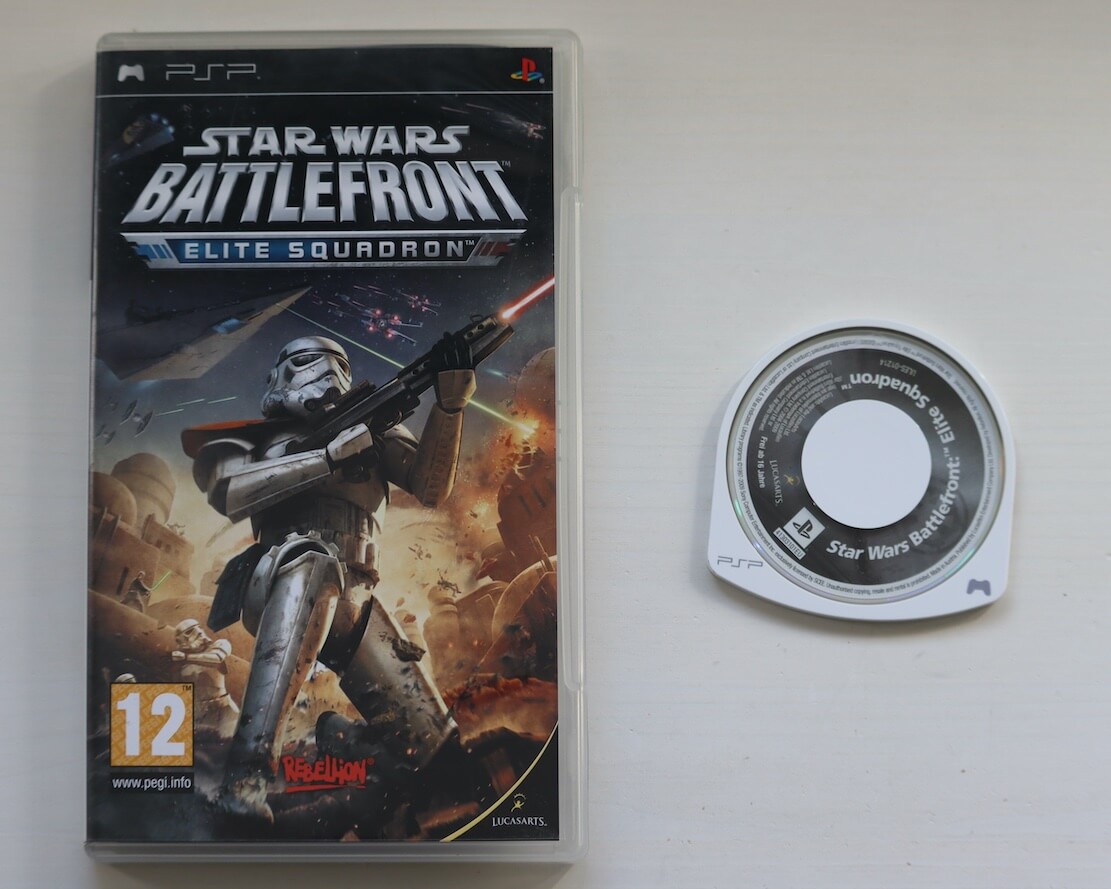
A typical retail game.
CDs and DVDs are too large and easily copyable. Furthermore, conventional readers won't work in a shaky environment (anyone who has tried listening to an audio CD on a Walkman while walking knows what I'm talking about). So, Sony's solution was a new invention from the ground up: the Universal Media Disc (UMD), a proprietary medium.
UMDs hold either 900 MB or 1.8 GB, depending on whether they are single-layer or dual-layer, respectively. They differ from DVDs and MiniDVDs not only in physical design but also in their internal data structure.
Apart from games, Sony published the 'UMD video' and 'UMD audio' specifications, allowing third-party distributors to ship their content to PSP users - remember, this was 2004, when the iPod Photo had a 2" display.
These discs are enclosed in a non-removable caddy; the centre is magnetic, so it attaches itself to the reader's motor once the disc is inserted.
Memory Stick Duo
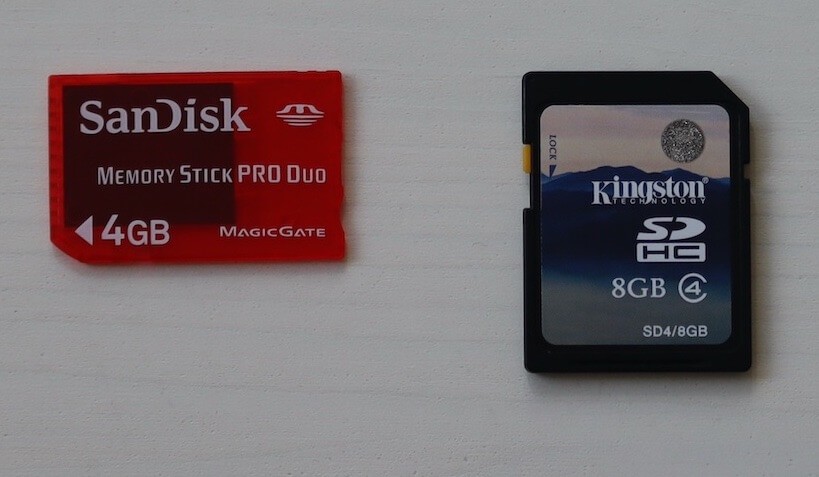
A Memory Stick next to a conventional SD card.
The 'portable' equivalent of the Memory Card is the Memory Stick Pro Duo, yet another example of Sony's insistence to bring another medium to a flooded market (remember the massive number of options back then? Even flashcarts had to accommodate many variants). This arrived during the boom in digital photography and cellphones, when people wanted lots of storage for a cheap price; and just before the SD card took over.
The Memory Stick, like the rest, is a protocol that interfaces internal memory (like Flash) with external peripherals in a way that's convenient. So, you may swap cards between the computer and the camera without having to dismantle anything. The 'Pro Duo' variant (used by the PSP) has a capacity of up to 32 GB, with speeds of 1.23 MB/s for reading and 0.54 MB/s for writing.
The PSP relies on the Memory Stick to store user-related content, such as saves, media, and games. It's formatted with the FAT32 file system, and the controller embedded within the Memory Stick may support MagicGate's digital rights management.
Unlike the PSP's internal RAM, the contents of the Memory Stick are not memory-mapped; the file system is accessed through system calls provided by kernel modules.
Network services
Eventually, Sony caught up with the competition and improved its online infrastructure. They even offered services not yet provided by Microsoft or Nintendo.
PlayStation Network
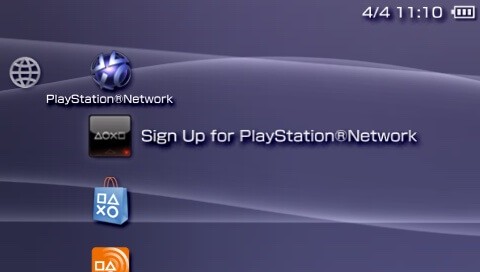
The PSN entry in XMB.
In response to Microsoft's Xbox Live and Nintendo's Nintendo Wi-Fi Connection, Sony had its own online infrastructure... PlayStation Network or 'PSN'.
This service superseded the primitive DNAS, previously deployed for the PlayStation 2. One of the additions was the use of a centralised authentication system.
Users could now register a free PSN account, enabling multiplayer gaming with other people around the globe via Wi-Fi connection.
It's worth mentioning that at first, the PSP didn't include many online services. This changed drastically with the release of the PlayStation 3, but I guess that is a story for a later article...
PlayStation Store
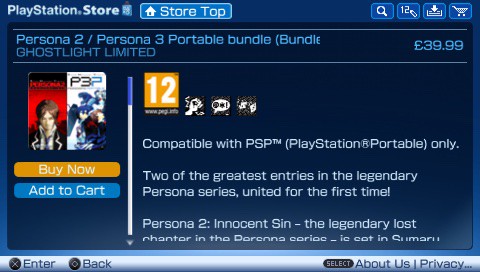
The PlayStation Store.
Another development that followed the debut PlayStation Network was the PlayStation Store. As the name indicates, it's an online marketplace that allows users to purchase games digitally and download them directly to their Memory Stick.
I suppose this was a welcome addition for small game studios, as physical distribution carried significant costs, which would eventually impact the price of the game. Strangely enough, a later model of the PSP called 'PSP Go' enforced this shift even further. By removing the UMD reader, it could only play titles acquired from the PlayStation Store.
Later on, the game catalogue drastically expanded with the arrival of PS1 games. These were downloaded to the Memory Stick and played like any other digital game. PS1 binaries on the PSP worked with the use of software emulation; Sony embedded an in-house emulator into the system to make all this work seamlessly.
Updatable content
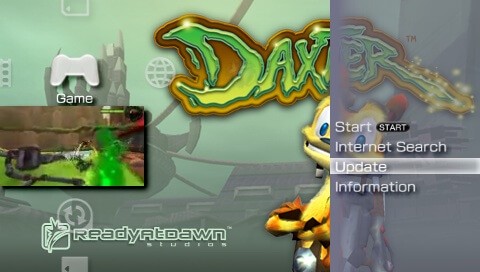
The 'Update game' option in XMB.
Last but not least, online services provided the opportunity to download game patches (in the form of 'updates') directly to the console.
Not many games made use of this feature, however. This is hard to imagine today, when large updates (the so-called day one updates) are often pushed before the game even reaches the store shelves...