Throughout the lifecycle (and struggles) of this console, Nintendo released numerous revisions in an attempt to correct its target audience and recover loyal customers.
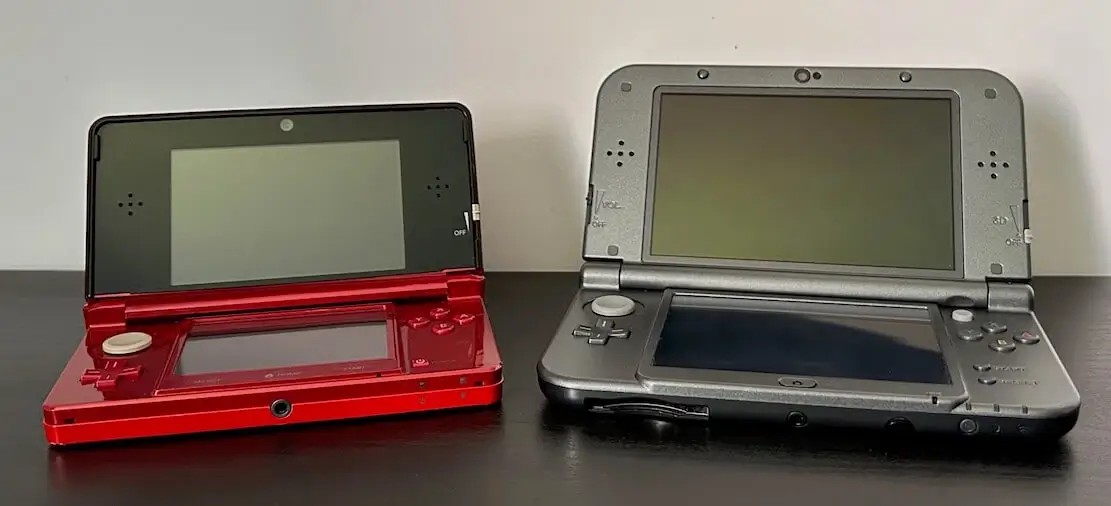
An original Nintendo 3DS (the first generation, from 2011) next to a New Nintendo 3DS XL (the last generation, from 2015).
From the architectural point of view, there were a total of six different models:
- Nintendo 3DS (2011) and Nintendo 3DS XL (2012): The debuting series featuring the original architecture. The only relevant difference between the XL and non-XL models is the screen size.
- Nintendo 2DS (2013): A cheaper alternative to the original Nintendo 3DS by removing the stereoscopic screen and featuring a Game Boy-inspired shape.
- New Nintendo 3DS (2014) and New Nintendo 3DS XL (2015): A re-engineering of the standard 3DS models. The 'New' variants exhibit an incremental hardware upgrade, an NFC reader, a larger button set and an improved stereoscopic system.
- New Nintendo 2DS XL (2017): The 'New' affordable alternative to the New Nintendo 3DS XL by omitting stereoscopic functionality.
Now, for this article, the focus will be on the original Nintendo 3DS (after all, it's the lowest common denominator for games). However, since the architectural differences of the 'New' series are worth studying, these will receive a dedicated section.