Overall, the SoC houses two audio blocks:
- A proprietary DSP exclusively programmed for sound operations. This is used by 3DS games.
- A variant of the Nintendo DS audio block named CSND. 3DS, DS and GBA games use it.
The 3DS-only hardware
You may know that this same DSP was previously bundled with the Nintendo DSi, but treated as an optional accelerator instead. With the 3DS, it's become the designated audio processor, so it's no longer a voluntary component.
The DSP is called CEVA TeakLite II and operates at ~134 MHz . It's manufactured by ParthusCeva, a company that provides synthesisable cores for audio processing , and I guess 'synthesisable' was the keyword Nintendo was looking for when they partnered.
Moving on, the DSP outputs stereo samples (2 channels) of up to 32 kHz of sampling rate and 16-bit resolution.
Next to this component, we can find 512 KB of RAM that is used by the DSP as a working area. It's double-buffered (256 KB per buffer), so both the CPU and DSP can read and write without interruption . Apart from that, the DSP comes with a dedicated DMA that can transfer data in and out of those 512 KB.
Operation
For all intents and purposes, games treat this as an opaque DSP. Thus, only Nintendo knows how to program it.
3DS programs, as a consequence of being developed using the official SDK, bundle a DSP firmware (solely authored by Nintendo) which is then uploaded to the DSP chip at runtime . Afterwards, programs rely on that firmware to execute audio-related routines. Furthermore, the audio services provided by the operating system further abstract the communication between the program and the DSP's firmware .
In any case, while the DSP firmware may change over the years, some capabilities have remained the same. For instance, the DSP can mix ADPCM and PCM samples. with support of up to 24 channels . There's also functionality for filtering and sequencing, including the generation of PSG-like sounds.
Interestingly enough, the steps followed for hacking the 3DS (so it can execute homebrew application) optionally involve extracting the HOME Menu's DSP firmware, so homebrew may use it to provide audio output .
The backwards-compatible block
At the other end of the spectrum, we find the CSND block. 3DS may use it as an extension of the DSP and DS/DSi/GBA games rely on it to replicate their hardware.
In terms of functionality, the CSND features 32 channels , which is twice the amount of the Nintendo DS counterpart.
Curiously enough, early homebrew defaulted to this block for providing sounds, while waiting for the DSP to be reverse-engineered.
Pipeline
Both DSP and CSND work independently and separately output their audio to the speaker.
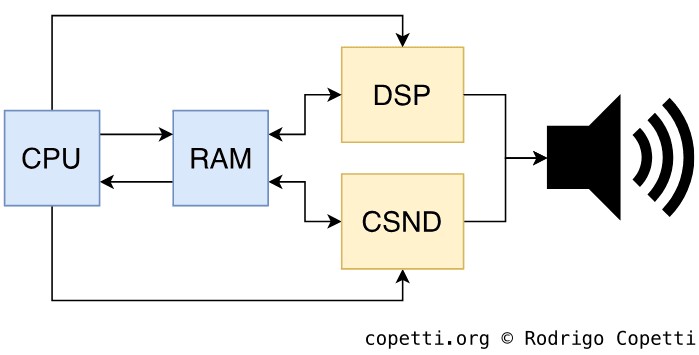
Overview of the audio pipeline.
As a curious note, the original Nintendo 3DS didn't play well with the speaker's capabilities, as Nintendo ended up providing troubleshooting guides for cases of buzzing noises and fluctuations with 3D slider , all caused by the design of the case.