To start with, games are written in 68k and Z80 assembly. It is only with the next generation of consoles (and the arrival of new CPUs) that programming languages became part of the toolbox.
Distribution medium
Following the trend of the 4th generation, the Neo Geo relies on cartridges as its sole medium for games.
Nevertheless, I must say, Neo Geo cartridges are the largest I have seen for a home console. This is due to the amount of dedicated chips housed within. Unlike the Super Nintendo, whose games could optionally expand the capabilities of the console, Neo Geo games are strictly required to bundle a considerable amount of circuitry.
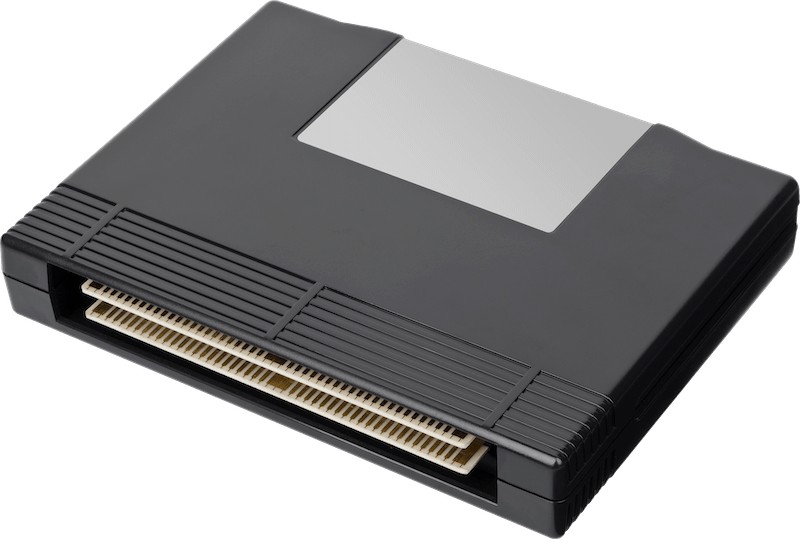
Generic cartridge for the Neo Geo . Notice the two boards sticking out.
I have already mentioned some parts of the cartridge system in previous sections, but let me give you a quick summary so you get a proper overview of how this system works.
As you may know, Neo Geo cartridges are made up of two boards. The first is called PROG Board and houses the following ROM chips:
- P ROM: Stores the program the 68000 executes. It is connected with a 16-bit data bus and up to 2 MB can be addressed (more will require a mapper).
- V ROM: Stores ADPCM audio samples read by the YM2610.
By contrast, the second board is the aforementioned CHA Board and embeds the following:
- The C ROMs and S ROM. These store sprite tiles and Fix tiles, respectively.
- An M1 ROM: Stores the Z80 program. As you may know, the addressing capabilities of the Z80 are very limited (in this case, the ceiling is 62 KB). So, M1 ROM access is interfaced by a dedicated mapper called NEO-ZMC (found in the cartridge), which enables up to 512 KB of memory to be addressed. This may be expanded by adding extra mappers to the CHA Board, or by adopting the NEO-ZMC2 (which enables up to 4 MB).
Keeping progress
As a home-arcade hybrid, SNK provided a rudimentary accessory to keep track of scores and progress: a proprietary Memory Card.
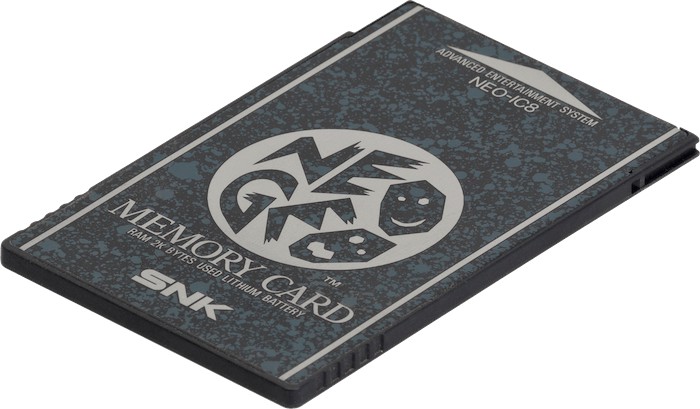
The Memory Card .
The Memory Card worked on both AES and MVS models. Options ranged from 2 KB to 16 KB of battery-backed Static RAM (SRAM) , though in all cases the battery was unserviceable.
The save data was structured as 64 B blocks distributed across five segments, while the System ROM provided I/O routines to operate it.
Having said that, whether arcade cabinets were actually 'prepared' for Memory Cards... That was another story.
I knew about the Memory cards from magazines, but official Neo Geo cabinets were rare in my town. Instead, we had plenty 'Video Sonic' cabinets supplied by Segasa. Some lacked all the buttons required to play properly, let alone a Memory Card slot!
- Proud Neo Geo connoisseur from Jerez, Spain