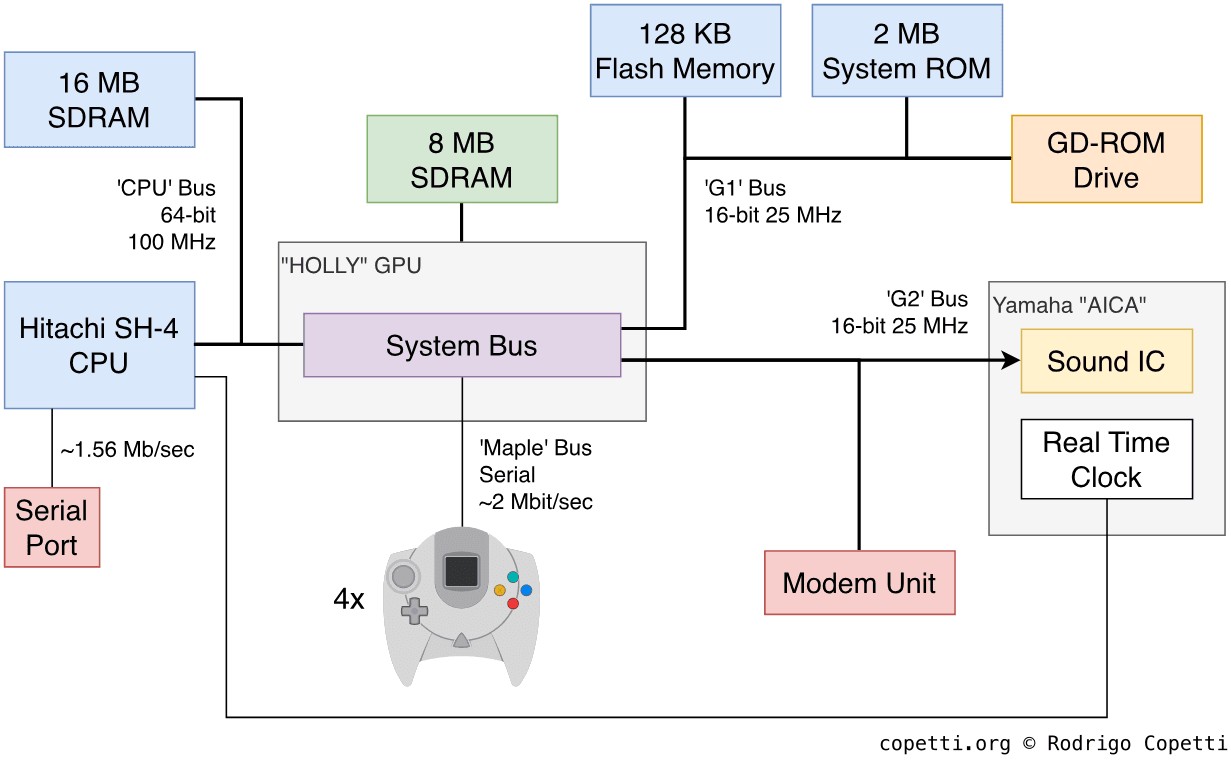
The main buses of this console.
The GPU also includes another module for handling most of the I/O. It is called System Bus and provides the following interfaces:
- The G1 interface: Where the BIOS ROM, along with its saved configuration, and the GD-ROM content can be accessed.
- The G2 interface: Provides access to the modem and sound controller.
- The Maple interface: Transfers chunks of data between the controllers (along with any connected accessories) and the CPU. It's a serial bus and provides a dedicated DMA.
- The SH-4 interface: Connects the main CPU for general-purpose communication.
- The DDT interface: Takes control of the CPU bus to access its main memory during DMA transfers.
- The PVR interface: Connects the CPU to the Tile Accelerator using a dedicated DMA channel.
External connections
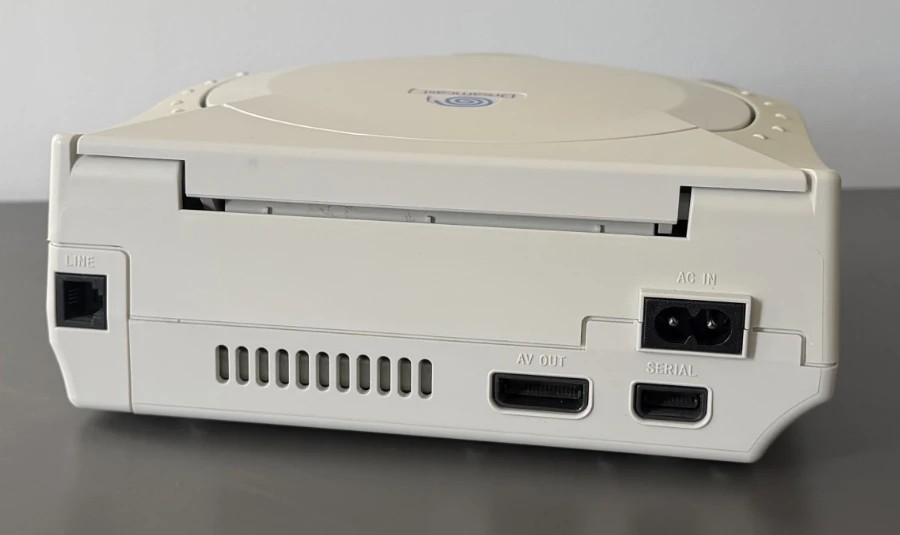
The back of the console, featuring modem, video out, and serial.
Behind the console, we find a modem and a Serial port. The modem is an interesting topic that will be further discussed in the 'Games' section. However, the serial port socket feels like a leftover from what Sega had envisioned before focusing on online services. It wasn't widely adopted, aside from connecting a handful of accessories:
- Japan-only official products like the VS Cable, which linked two Dreamcasts for multiplayer gaming.
- Debugging hardware for development purposes.
- Third-party peripherals, mostly aftermarket.