The audio functionality is handled by a custom chip called AICA. It was designed by Sega's long-term partner and audio industry leader, Yamaha.
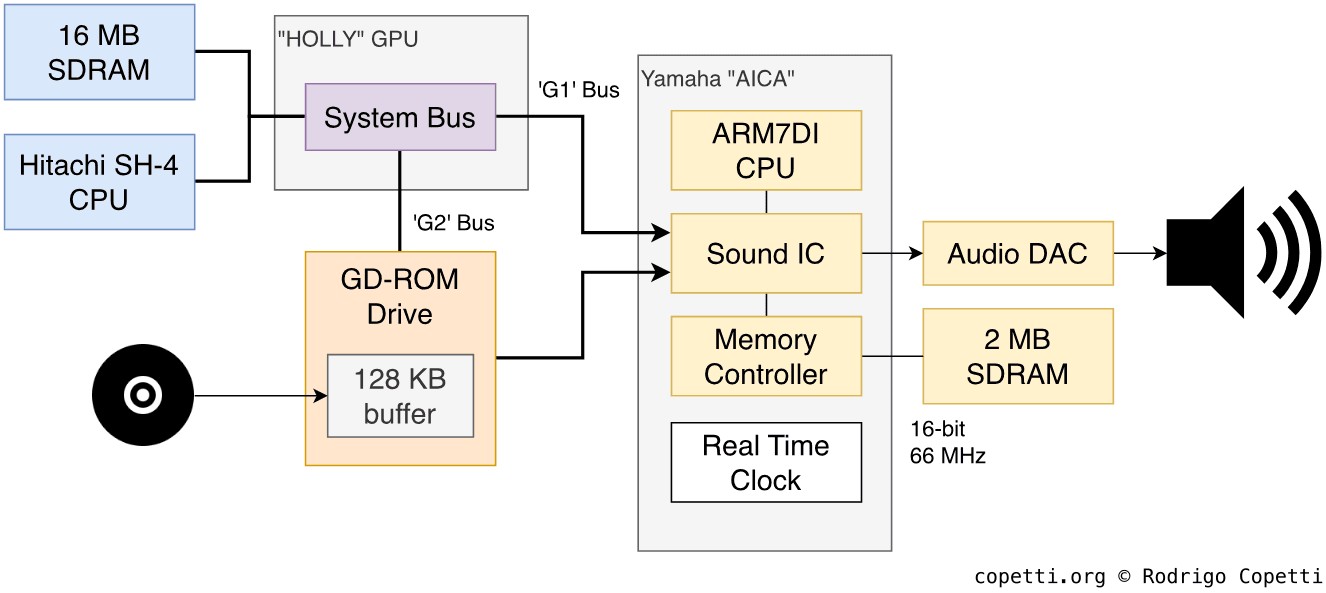
Architecture of the audio subsystem.
This is a continuation of the SCSP found in the Saturn, in the sense that it's fundamentally the same architecture, but with modernised parts. That being said, AICA is composed of four components :
- The Sound Integrated Circuit (IC): A set of modules (synthesiser, digital signal processor, and mixer) that generates the audio signal and applies effects to it. It supports up to 64 channels, either Pulse-Code Modulation (PCM) with a resolution of 16 or 8 bits and a sampling rate of 44.1 kHz, or 4-bit Adaptive Differential PCM (ADPCM). Overall, this provides optimal quality for playing audio.
- Notice how Frequency Modulation (FM) is now a thing of the past. Originally adopted to overcome the constraints of 80s technology, FM has now been completely superseded by sample-based channels, granting free rein to music composers.
- Curiously enough, it also provides two MIDI pins for connecting a MIDI instrument, although these are intended during development.
- 2 MB of SDRAM: Stores sound data and programs. It's filled by the main CPU using DMA.
- An ARM7DI running at ~2.82 MHz: Controls the Sound IC. This CPU is programmed by booting a small piece of software (called driver) stored in SDRAM, which interprets the audio data and manipulates the Sound IC accordingly.
- If you're wondering, a similar but beefier CPU is also found in the Game Boy Advance.
- Memory Controller: Interfaces the 2 MB of SDRAM.
To help with development, the official SDK included multiple sound drivers for different needs (e.g. sequencing, decoding, etc.).
The great leap
We've come so far since the days of the Mega Drive/Genesis. In order to show how much progress has been made in sound synthesis, here is an example featuring two games, one for the Mega Drive and the other for the Dreamcast, that used the same musical composition.

Video - Sonic 3D Blast (1996) for the Mega Drive / Genesis.
The predecessor performs FM synthesis to generate audio signals on the fly.

Video - Sonic Adventure (1999) for the Dreamcast.
The new audio subsystem processes PCM samples without any hassle.
You can also try this widget if you want to switch between the two on-the-fly:
Interactive player available in the modern edition
Audio samples
MegaDrive / Genesis: Sonic 3D Blast (1996).
Dreamcast: Sonic Adventure (1999).
Behind the scenes
Rather than dealing with hardware-specific FM arrangements, the composers of Sonic Adventure were free to produce their soundtrack in-house. It also didn't matter how many instruments the track used as, in the end, the score would always be mixed down before being exported as stereo PCM audio.
If you look at the contents of the game disc, the music is encoded in ADX, a lossy format developed by CRI Middleware. This extra layer enables the game to decode and stream audio data from the GD-ROM to the Sound IC without running out of memory or bandwidth. Furthermore, the respective driver could be implemented in many ways, as multiple approaches existed to balance the workload between the main CPU and ARM7.
Staying alive
For some reason, AICA is also responsible for providing the system with a Real Time Clock (RTC), and is connected to a clock battery to continue working without AC power.